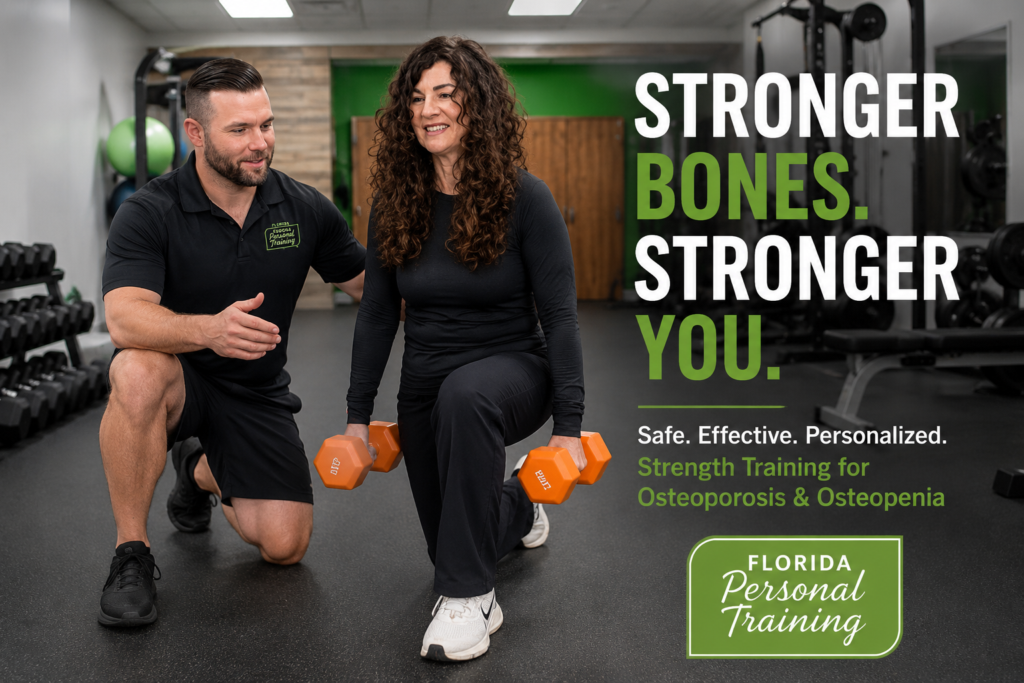
Heavy Resistance Training for Osteoporosis and Osteopenia: Is Lifting Heavier the Missing Piece?
For years, people diagnosed with osteopenia or osteoporosis were often given very cautious exercise advice: walk more, use light weights, and avoid doing anything that might put too much stress on the bones.
We now know the picture is more nuanced.
Walking and low-impact activity remain valuable for overall health, but appropriately prescribed resistance training—including relatively heavy resistance training for suitable individuals—may provide a stronger stimulus for maintaining or improving bone strength. Research in postmenopausal women with low bone mass has shown encouraging improvements in bone mineral density and physical function when high-intensity resistance and impact training is performed under close professional supervision.
The key words are appropriately prescribed and supervised. Osteoporosis is not a reason to be afraid of strength training, but it is a reason to train intelligently.
Why Bones Need More Than Walking
Bones are living tissue. Like muscles, they respond to the demands placed upon them.
Resistance exercise requires your muscles to generate force against an external load. Those forces are transmitted to the skeleton, providing a mechanical stimulus that helps support bone health. The Bone Health & Osteoporosis Foundation recommends both weight-bearing and muscle-strengthening exercise as important components of maintaining bone density.
Walking certainly has benefits. It improves cardiovascular fitness, endurance and general activity levels. But if protecting bone and maintaining physical function are priorities, strength training deserves an important place alongside walking.
What Do We Mean by “Heavy” Resistance Training?
The word heavy can sound intimidating, particularly to someone who has been told that their bones are fragile.
Heavy does not mean grabbing the biggest weight in the gym and seeing what you can lift.
It means using a resistance that is challenging relative to your individual strength and ability, with excellent technique and appropriate progression.
One of the best-known studies in this area is the LIFTMOR trial, which studied postmenopausal women with osteopenia or osteoporosis. Participants in the high-intensity group completed supervised training twice per week for eight months. The resistance exercises were performed at greater than 85% of one-repetition maximum, generally using five sets of five repetitions.
Compared with a low-intensity home exercise program, the high-intensity group experienced better outcomes in lumbar-spine and femoral-neck bone mineral density as well as measures of physical function. Only one minor adverse event—a lower-back muscle spasm—was reported in the high-intensity group.
That’s an exciting finding, but it shouldn’t be interpreted as permission for everyone with osteoporosis to immediately start lifting at that intensity. Participants were screened and their training was highly supervised.
Why Strength Matters Beyond Bone Density
The benefits of resistance training aren’t limited to what appears on your next DEXA scan.
Building strength can improve your ability to:
- Get out of a chair
- Climb stairs
- Carry groceries
- Maintain balance
- Recover from a stumble
- Perform household activities
- Continue traveling and enjoying recreational activities
- Remain independent
This matters enormously for someone with osteoporosis because preventing a fracture isn’t only about making bones stronger—it’s also about reducing the likelihood of falling in the first place.
Balance, posture and functional exercise can improve movement and help decrease fall risk, which is why these components should complement resistance training.
Osteoporosis Doesn’t Mean “Fragile—Don’t Exercise”
A diagnosis of osteoporosis can understandably make people cautious.
Unfortunately, becoming excessively cautious can create another problem.
If you stop challenging your body, muscles can become weaker. Balance may decline. Everyday activities can become harder. Eventually, the very strategy intended to protect you can leave you less physically capable.
The goal shouldn’t be to eliminate physical stress.
The goal is to provide the right amount of stress, in the right way, for the right person.
Resistance training can include free weights, machines, resistance bands and body-weight exercises. The Bone Health & Osteoporosis Foundation recommends muscle-strengthening exercise two to three days per week as part of a bone-healthy exercise program.
But Heavy Training Isn’t Appropriate for Everyone
This is where individualized programming becomes extremely important.
Someone with mild osteopenia and years of strength-training experience is very different from someone with severe osteoporosis, multiple vertebral compression fractures, significant balance problems and no previous resistance-training experience.
Before beginning a high-intensity program, factors such as these should be considered:
- Bone density and fracture risk
- Previous fractures
- Spine health
- Balance and fall history
- Joint problems
- Current strength and conditioning
- Exercise experience
- Other medical conditions
- Medications
- Movement technique
People at high fracture risk should work with a physical therapist or other appropriately qualified healthcare professional to establish a safe exercise program.
Certain Movements Require Extra Care
Exercise selection matters just as much as the amount of weight being lifted.
For people with osteoporosis—particularly those with vertebral fractures—repetitive or loaded forward bending of the spine and certain forceful twisting movements can increase stress on vulnerable vertebrae. The Bone Health & Osteoporosis Foundation specifically cautions people with osteoporosis about forward spinal flexion and emphasizes appropriate body alignment and movement modifications.
That doesn’t mean you should become afraid to bend or move.
It means learning safer strategies, such as maintaining appropriate spinal alignment and using a hip-hinge pattern when appropriate. A physical therapist can determine which movements and modifications are appropriate for an individual’s fracture risk and medical history.
Start Where You Are—Not Where You Want to Finish
Someone who has never lifted weights shouldn’t begin with heavy resistance.
A well-designed program progresses gradually.
Early training might focus on learning how to squat, hinge, push, pull, carry and maintain good posture with relatively light resistance. As technique, strength and confidence improve, resistance can progressively increase when appropriate.
Eventually, what once felt “heavy” becomes manageable.
That’s the purpose of progressive resistance training.
You earn heavier weights by first mastering movement.
What About Osteopenia?
Osteopenia is often viewed as simply a warning that osteoporosis may be coming.
A better way to look at it is as an opportunity to act.
If your bone density is already declining, this is an excellent time to evaluate your strength-training habits, nutrition, balance, fall risk and overall lifestyle with your healthcare team.
You don’t need to wait for osteoporosis—or a fracture—to begin taking bone health seriously.
Exercise Is Only One Part of the Plan
Resistance training is powerful, but osteoporosis management isn’t simply an exercise program.
Bone health also involves appropriate nutrition, including adequate calcium and vitamin D, along with medical evaluation and medication when indicated.
Exercise should complement—not replace—the osteoporosis treatment plan recommended by your healthcare provider.
Where Physical Therapy and Personal Training Can Work Together
For someone with osteoporosis, there can be a significant difference between simply being told to “exercise” and having a program specifically designed around their body.
This is where collaboration between Physical Therapy and Personal Training can be especially valuable.
If a client has osteoporosis, a history of fracture, pain, significant postural changes, balance problems or other medical considerations, a Physical Therapist can evaluate movement, identify precautions and help determine an appropriate starting point.
Once those parameters are established, progressive strength training can help build the strength and physical capacity needed for everyday life.
Rather than treating rehabilitation and fitness as two completely separate worlds, the goal should be a continuum:
Assess → Move Safely → Build Strength → Progress Appropriately → Stay Independent
The Bottom Line
Having osteopenia or osteoporosis does not automatically mean you should avoid challenging resistance exercise.
For appropriately screened individuals, research suggests that supervised high-intensity resistance training can improve bone-density measures, strength and physical function. But the evidence does not mean heavy lifting is universally safe or appropriate, and the research supporting very high-intensity training has important limitations.
The answer isn’t simply “lift heavy.”
It’s:
Lift appropriately. Progress gradually. Use excellent technique. And get professional guidance when your fracture risk or medical history warrants it.
At Florida Personal Training, our goal is to help adults build the strength they need not only for healthier bones—but for a stronger, more active and independent life.
Strong muscles. Stronger bones. Greater confidence for life.