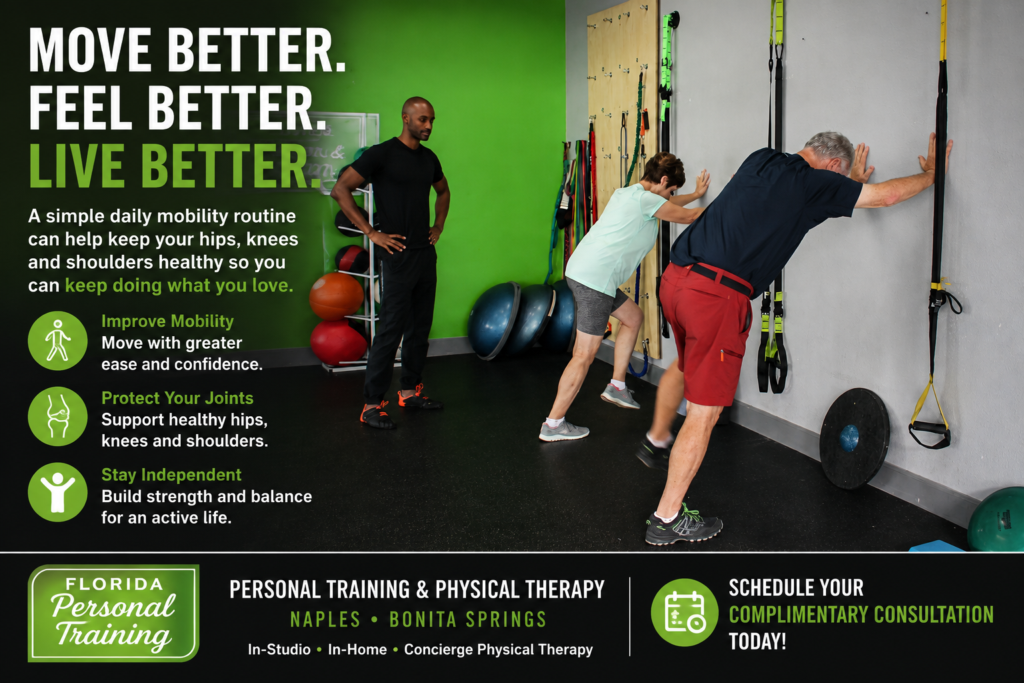
A Simple Daily Mobility Routine for Adults 55+
Stiff hips when you get out of a chair? Knees that take a few minutes to “warm up”? Shoulders that don’t move quite as freely as they used to?
These changes are common as we get older, but they don’t mean you should stop moving. In many cases, doing the opposite—moving consistently and maintaining strength—can help you preserve mobility and continue doing the activities you enjoy.
For adults over 55, maintaining healthy joints isn’t about becoming extraordinarily flexible. It’s about preserving enough mobility, strength, balance, and control to walk comfortably, climb stairs, reach overhead, play golf or pickleball, travel, exercise, and remain independent.
A simple daily mobility routine can be an excellent place to start.
Why Mobility Becomes More Important After 55
Mobility and flexibility aren’t exactly the same thing.
Flexibility generally describes how much a muscle can lengthen or a joint can move through a range of motion.
Mobility is your ability to actively control movement through that range.
That distinction matters.
You don’t simply need enough flexibility to lift your leg—you need the strength and control to step onto a curb safely. You don’t just need shoulder range of motion—you need to be able to reach into a cabinet and control your arm while carrying something.
The National Institute on Aging notes that maintaining flexibility can make exercise and everyday activities such as reaching and bending easier. Federal physical activity guidance also encourages older adults to combine aerobic exercise, muscle strengthening, and balance work rather than relying on just one type of activity. (National Institute on Aging)
Healthy aging requires movement—and movement requires usable mobility.
Why Do Hips, Knees, and Shoulders Get Stiff With Age?
Age itself isn’t the only reason.
How much you move throughout the day matters, too.
Think about a typical day. You may spend hours sitting at a desk, driving, watching television, or using a phone or computer. Your hips and knees remain in similar positions while your shoulders spend much of the day in front of your body.
Over time, a combination of inactivity, previous injuries, arthritis, loss of strength, and reduced movement variety can make certain activities feel more difficult.
That can create an unfortunate cycle:
Joint feels stiff → You move less → Strength and mobility decline → Movement becomes harder → You move even less.
For people with arthritis, physical activity can actually help reduce joint pain and improve function and quality of life. (CDC)
The goal is not to force a painful joint through a range it doesn’t tolerate. It’s to find safe, comfortable movement you can perform consistently.
A Simple Daily Mobility Routine for Adults 55+
Try this routine once a day or use portions of it as a warm-up before walking or strength training.
Move slowly and comfortably. None of these movements should produce sharp pain.
1. Chair Hip Marches
Helps with: Hip mobility, hip strength, walking and stair climbing.
Sit tall near the front of a sturdy chair with both feet on the floor.
Slowly lift one knee toward your chest without leaning backward. Lower it with control and repeat with the opposite leg.
Try: 8–12 repetitions per side.
Make it more challenging: Perform the movement standing while holding a stable counter or chair for support.
Why it matters
Your hips play an enormous role in walking, climbing stairs, getting into a car and maintaining balance. Maintaining hip movement and strength can make these everyday activities easier.
2. Supported Hip Flexor Stretch
Helps with: Hip mobility and standing posture.
Stand in a staggered stance while holding a counter or sturdy chair.
Keep your torso upright and gently shift your weight forward until you feel a comfortable stretch through the front of the hip on the back leg.
Avoid arching your lower back.
Hold: 20–30 seconds.
Repeat: 2 times per side.
This can be particularly useful if you spend a significant portion of your day sitting.
3. Seated Knee Extensions
Helps with: Knee movement and quadriceps activation.
Sit upright in a sturdy chair.
Slowly straighten one knee until the leg is comfortably extended. Pause briefly, then lower your foot back to the floor.
Alternate sides.
Try: 10–15 repetitions per leg.
The quadriceps muscles on the front of your thighs are important for walking, climbing stairs and getting out of chairs.
4. Sit-to-Stand
Helps with: Hips, knees, leg strength and everyday independence.
Sit toward the front of a sturdy chair with your feet underneath you.
Lean slightly forward from your hips and push through your feet to stand.
Slowly return to the chair with control.
Use your hands for assistance if necessary.
Try: 8–12 repetitions.
This is more than an exercise. It’s practice for something you need to do throughout your entire life.
Getting up from chairs, toilets, restaurant booths and car seats all require similar strength and mobility.
5. Ankle Rocks
You may be wondering what your ankles have to do with your knees and hips.
Quite a lot.
Stand facing a wall or counter for support. Keep your heel on the ground while gently moving your knee forward over your foot. Return to the starting position.
Try: 8–12 repetitions per side.
Good ankle mobility can help you squat, walk and negotiate stairs more comfortably.
6. Shoulder Wall Slides
Helps with: Shoulder mobility and overhead reaching.
Stand facing a wall with your hands or forearms against it.
Slowly slide your arms upward as far as you can comfortably go without shrugging your shoulders or forcing the movement.
Return slowly.
Try: 8–10 repetitions.
This movement can help maintain the range needed for activities such as putting dishes away, reaching into a closet, washing your hair or putting on a shirt.
7. Shoulder Blade Squeezes
Helps with: Upper-back strength, shoulder positioning and posture.
Sit or stand tall.
Gently draw your shoulder blades backward and slightly downward—as though you’re putting them into your back pockets.
Avoid shrugging.
Hold for 2–3 seconds and relax.
Try: 10–15 repetitions.
Your shoulders don’t operate independently. The muscles of your upper back and shoulder blades help create a stable foundation for healthy arm movement.
8. Gentle Upper-Body Rotations
Helps with: Thoracic mobility and everyday turning.
Sit tall in a chair with your feet firmly planted.
Cross your arms over your chest and slowly rotate your upper body to one side without forcing the movement.
Return to center and rotate to the other side.
Try: 5–8 repetitions each direction.
Being able to rotate comfortably helps with activities such as checking behind you, reaching across your body, playing golf and moving through daily life.
How Long Should a Daily Mobility Routine Take?
You don’t need a 45-minute stretching session every morning.
For many adults, 5–10 minutes of purposeful daily movement is a realistic starting point.
Consistency is more important than occasionally performing a long routine.
Attach your mobility routine to something you already do:
- After your morning coffee
- Before your daily walk
- Before a workout
- After sitting for an extended period
- While watching television
- Before going to bed
The easier it is to incorporate into your lifestyle, the more likely you are to continue doing it.
Mobility Alone Isn’t Enough
This is an important point.
Stretching and mobility exercises should not replace strength training.
Strong muscles help support and control your joints.
For adults 65 and older, current CDC recommendations include at least 150 minutes of moderate-intensity aerobic activity per week, muscle-strengthening activity at least two days per week, and activities that improve balance. (CDC)
That means a well-rounded healthy-aging exercise program should include:
Mobility + Strength + Balance + Cardiovascular Exercise
Not one instead of the others.
Regular physical activity can also help older adults maintain independence, improve bone health, and reduce the risk of falls. (CDC)
Should You Stretch Through Joint Pain?
No.
Mobility exercises should create a feeling of movement or a gentle stretch—not sharp, severe or increasing pain.
The National Institute on Aging recommends stretching when muscles are warmed up and avoiding stretching so far that it hurts. (National Institute on Aging)
If a joint is persistently painful, swollen, unstable, or losing range of motion, simply stretching harder isn’t the answer.
That’s when an evaluation may be appropriate.
When Physical Therapy Can Help
Sometimes stiffness isn’t just stiffness.
Previous injuries, arthritis, joint replacements, rotator cuff problems, back conditions, balance deficits and movement compensations can all affect how your body moves.
At Florida Personal Training, our team of Physical Therapists can evaluate painful or restricted movement and determine what may be contributing to the problem.
From there, we can help develop an individualized plan to improve mobility, restore strength and safely progress you toward the activities that matter to you.
This is particularly valuable when you’re unsure whether you should stretch it, strengthen it, modify it—or have it evaluated.
Personal Training for Adults Over 55
Once you have adequate mobility, you need to use it.
That’s where strength training becomes essential.
At Florida Personal Training, we specialize in helping adults 55+ build the strength, balance, mobility and confidence needed to remain active and independent.
Your exercise program shouldn’t be based solely on your age.
It should be based on your body, your medical history, your current abilities and the life you want to continue living.
Maybe that means being able to:
- Play 18 holes of golf
- Return to pickleball
- Travel without worrying about stairs
- Get down on the floor with your grandchildren
- Carry your own luggage
- Garden comfortably
- Walk longer distances
- Continue living independently
Those are fitness goals worth training for.
Frequently Asked Questions About Mobility After 55
How often should adults over 55 do mobility exercises?
Gentle mobility work can often be performed daily when it feels comfortable. The appropriate frequency depends on your health, joints, previous injuries and the exercises you’re performing.
Is stretching good for arthritis?
Appropriate physical activity can help people with arthritis reduce joint pain and improve physical function. (CDC) If arthritis causes significant pain or limits movement, work with a healthcare professional to determine which exercises are appropriate for you.
Should I do mobility exercises before or after strength training?
Gentle, active mobility exercises can be useful before exercise. Longer static stretches are often more comfortable after your muscles are warm. The National Institute on Aging recommends stretching after warming up or following endurance or strength exercise. (National Institute on Aging)
Can mobility exercises prevent joint replacement?
No exercise routine can guarantee that you’ll avoid joint replacement. Joint health is influenced by many factors, including arthritis severity, previous injury, anatomy, genetics and overall health. However, maintaining appropriate physical activity, strength and mobility can support physical function.
Is walking enough exercise after 55?
Walking is excellent cardiovascular activity, but it doesn’t replace resistance and balance training. Older adults benefit from a combination of aerobic, muscle-strengthening and balance activities. (CDC)
The Bottom Line: Keep Moving So You Can Keep Moving
Healthy aging isn’t about trying to move like you did at 25.
It’s about maintaining the movement you need to enjoy life at 55, 65, 75, 85 and beyond.
Your hips need to move so you can walk and climb stairs.
Your knees need strength and mobility so you can stand up and remain active.
Your shoulders need movement so you can reach, lift and perform everyday activities.
A few minutes of mobility work each day, combined with regular strength, balance and cardiovascular training, can help you maintain the physical capacity you need for an active life.
Don’t wait until you lose mobility to start working on it.
At Florida Personal Training, our Personal Training and Physical Therapy teams help adults build stronger, more capable bodies through individualized programs designed around their goals and abilities.
Move better. Get stronger. Stay independent. Keep doing what you love.